APPOINTMENTS
Request an appointment onlineUHealth Tower delivers award-winning, expert medical care close to home. Set in the heart of Miami’s health district, UHealth Tower is the flagship of UHealth – University of Miami Health System, the first and only academic-based hospital in South Florida. UHealth Tower provides research-driven, leading-edge care in multiple specialties that’s highly personalized to your needs.
EXPERT MEDICAL CARE IN MULTIPLE SPECIALTIES
If you have a medical emergency, please call 911.

24-HOUR EXPERT EMERGENCY CARE
When every minute matters, UHealth Tower is close to you and ready to offer next-level care 24/7 from board-certified emergency medicine physicians highly trained for emergency situations. We offer advanced cardiovascular and stroke care, state-of-the-art radiology and imaging for rapid diagnoses, and more.
Learn More
A MULTIDISCIPLINARY APPROACH
TAILORED TO YOU
UHealth Tower physicians and staff from multiple specialties work together in teams, sharing information and perspectives to create customized care plans for each patient. This integrated, team-based approach is carried through from diagnosis to treatment and follow-up, always with your particular needs in mind.
RANKED #1 IN OPHTHALMOLOGY
for the 22nd time
NATIONALLY RANKED #20
in Neurology & Neurosurgery
HIGH PERFORMING
in 3 Adult Specialties
in 10 Procedures / Conditions
- Cancer
- Geriatrics
- Diabetes & Endocrinology
- Lung Cancer Surgery
- Kidney Failure
- Heart Failure
- COPD
- Aortic Valve Surgery
- Pneumonia
- Colon Cancer Surgery
- Prostate Cancer Surgery
- Uterine Cancer Surgery
- Leukemia, and Lymphoma, & Myeloma Surgery
WHY CHOOSE UHEALTH?
- Expert, leading-edge patient care delivered in 100+ specialties by top-ranked doctors
- South Florida’s only academic-based medical system, powered by the groundbreaking research of the University of Miami Leonard M. Miller School of Medicine
- Thousands of clinical trials, which fastrack breakthrough research and the latest discoveries from laboratory to bedside
- 1,800+ highly trained providers and scientists working in teams to deliver customized patient care from diagnosis to treatment and follow-up
- No. 1 eye hospital in the United States, Bascom Palmer Eye Institute
- Only National Cancer Institute–designated cancer center in South Florida, Sylvester Comprehensive Cancer Center
- Pioneering, minimally invasive cardiac surgery program
- South Florida’s leader in robotic surgery — 5,000+ robotic surgeries performed in multiple specialties
- Recognized in 15 areas of care, and nationally ranked in two specialties, per U.S. News & World Report
- 30+ outpatient sites in Miami-Dade, Broward, Palm Beach and Collier counties, including The Lennar Foundation Medical Center in Coral Gables
Insurance Plans
View a list of insurance plans accepted at the University of Miami Health System.
View Accepted Insurance Plans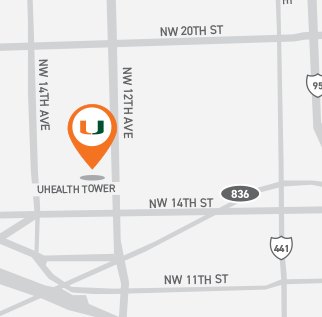
UHealth Tower
1400 NW 12th Avenue
Miami, FL 33125
305-325-5511
Open 24 Hours
7 days a week